The Historic Year That Changes Everything in Leadership
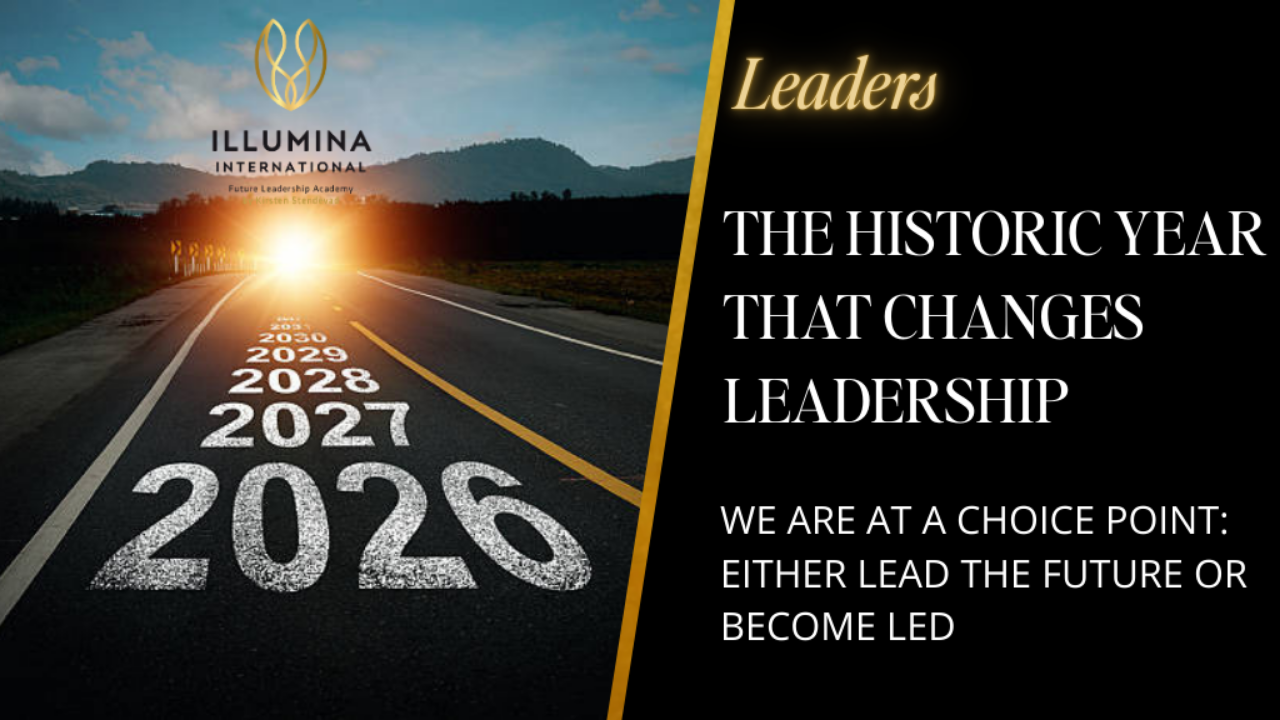
Are You Ready for 2026 - The Historic Year That Changes Everything in Leadership?
By Kirsten Stendevad, Nordic bestselling author and leadership developer
Prepare Yourself: 2026 Will Define Your Leadership Legacy. Deloitte's newly released Tech Trends 2025 report reveals that AI has become so foundational to enterprise operations that it now functions like electricity - invisible yet essential to everything we do. This is not just another gradual development. It represents a fundamental rewriting of the rules that makes business as usual a direct path to obsolescence. As a leader, you can no longer just be a skilled administrator or strategic thinker.
McKinsey's State of AI 2025 analysis shows that 89% of organizations now regularly use AI, yet nearly eight in ten report no material impact on their bottom line. What's revolutionary is not the technology adoption itself - it's the growing chasm between those who are fundamentally transforming their organizations and those merely experimenting. Companies experiencing the greatest impact are redesigning workflows, reimagining business models, and treating AI as a catalyst for organizational transformation rather than a productivity tool. The convergence of AI transformation, climate transition, and geopolitical volatility creates momentum for change without historical precedent.
Deloitte's 2025 Global Human Capital Trends research, surveying nearly 10,000 leaders across 93 countries, demonstrates how traditional forms of leadership are becoming increasingly ineffective in meeting today's complexity. The data reveals a stark reality: 75% of workers seek stability while 85% of leaders recognize the need for unprecedented agility. Something new is needed. And it needs to happen fast. Organizations face a critical gap - leaders must navigate seemingly impossible tensions between control and empowerment, stability and speed, automation and augmentation.
2026 becomes particularly crucial because the development requires more than just new skills - it requires a fundamental paradigm shift in leaders' way of thinking and operating. This is supported by Harvard researchers Kegan and Lahey's documentation of traditional leadership development's inadequacy. There is a need for a fundamental expansion of leaders' consciousness level and cognitive capacity. The pressure is high because the best employees increasingly opt out of organizations with outdated leadership. They actively seek leaders who can navigate complexity and create meaning through higher forms of consciousness and systems understanding.
For me, having worked with leadership development for two decades, it's remarkable that what was previously considered exotic about my approach - for example, introducing brain training and advanced stress-reduction technologies known from the military, as well as teaching new leadership principles such as balance between analytical and intuitive intelligence - now becomes obviously necessary. Methods to activate both systemic thinking and collective intelligence, and tools to create from the future instead of just repairing the past, are no longer just for progressive first movers but fundamental for all who want to remain relevant.
McKinsey's 2025 research identifies that high-performing organizations distinguish themselves through bold ambitions to transform their businesses. These leaders are more than three times as likely to use AI to bring about transformative change rather than incremental improvements. The common thread: they redesign workflows, invest in developing expanded leadership capacity, and focus simultaneously on growth, innovation, and human performance.
Deloitte's analysis reveals four critical development dimensions for future leaders:
- The capacity to see and navigate systemic connections across traditional organizational boundaries, particularly as organizations must balance competing demands for stability and rapid adaptation.
- The ability to integrate technological insight with human development in a time where AI agents are moving from experimentation to scaled deployment, fundamentally changing how work gets done.
- Skills in facilitating innovation and transformation in complex adaptive systems where 74% of surveyed leaders say prioritizing human capabilities alongside business outcomes is critically important.
- Expanded consciousness to create meaning and direction in unprecedented complexity, navigating the tensions between short-term efficiency gains and long-term value creation.
Organizations that actively develop these capacities in their leaders are significantly better positioned to handle future challenges. This is supported by recent analyses showing how companies with transformative leaders systematically outperform their competitors in both innovation and value creation. The AI paradox McKinsey identified is clear: nearly 80% of companies use generative AI, yet the same percentage report no significant bottom-line impact. The difference lies not in technology adoption but in leadership transformation.
For leaders, 2026 therefore becomes the year where investment in personal development and expanded leadership capacity becomes crucial. The choice is no longer whether to develop - it's how and how quickly. Leaders who continue to operate from traditional consciousness levels will experience their ability to create value and results eroding at an accelerating pace. The experience gap is widening as entry-level roles disappear and the nature of work fundamentally shifts.
Top management should recognize that the time for half-hearted development initiatives is over. 2026 will be the year where the consequences of not developing oneself and one's employees become brutally apparent. It will be the year where the divide between future pioneers and past maintainers manifests in both bottom line and market position. Organizations stuck in pilot mode while competitors redesign their entire operating models will find themselves increasingly irrelevant.
In 12 months, you will either be among those who shaped the future or among those who fell behind because they thought transformation was optional. There is no middle ground, no possibility to wait and see. 2026 will be the year that defines your legacy as a leader. What do you choose?
Sources:
- Deloitte (2025): Tech Trends 2025
- Deloitte (2025): Global Human Capital Trends: Turning Tensions into Triumphs
- McKinsey (2025): The State of AI: Agents, Innovation, and Transformation
- McKinsey (2025): AI in the Workplace: A Report for 2025
- Kegan & Lahey: Immunity to Change, Harvard Business Press
Your Next Step
At Illumina Future Leadership Academy, we help leaders, entrepreneurs, changemakers and their teams thrive today and shape a brighter tomorrow via regenerative resilience, turning crisis into opportunity, and developing AI-complementary human capabilities.
Our next cohorts are forming now.
Start immediately with brain
training that builds up to 25% more focus,
memory, and decision-making skills, plus the neuroplasticity that
maximizes your benefits and transformation when the group
trainings begin.
Continue with trigger-freeing technology to stop allowing the past to interfere with your present and future. Add individual expert sessions to replace career with Calling and learn the 7 Facets of Future-Intelligent leadership.
Schedule a call to explore your options if you feel drawn to this leadership OS upgrade.
Stay connected with updates & news
Join our mailing list to stay in the loop
You can unsubscribe any time with one click
No spam. No sharing with third parties. Only bright ideas & insights. ILLUMINA is latin and means "Please Enlighten Me"