Our leaders are toasting on the Titanic
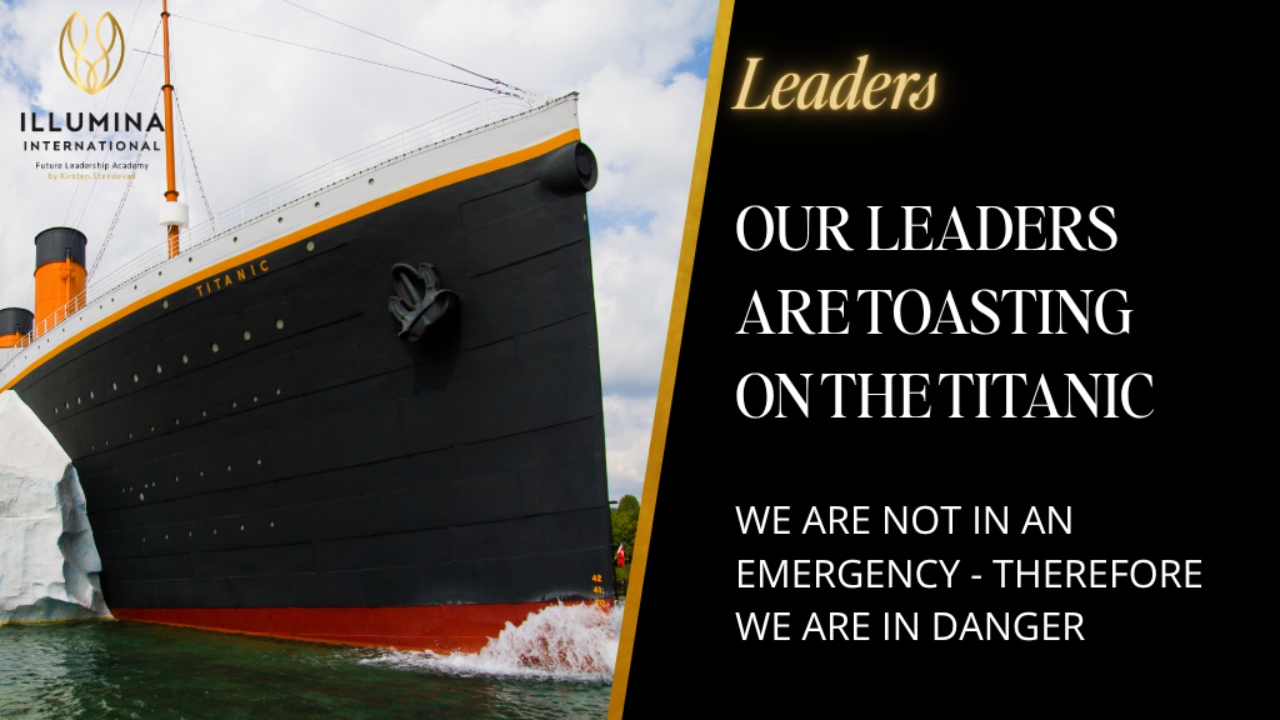
We are not in crisis. That is precisely why we are in danger. The greatest leadership risk ahead is not in your strategy, your technology or your market. It may be sitting in the leader.
By Kirsten Stendevad, author, speaker, and founder of Illumina Future Leadership Academy
On 14 April 1912, the Titanic received six telegrams warning of ice. The ship sailed on at near-full speed while dinner was served.
We tell the story as though the iceberg were the problem. It was not. What mattered had been settled long before. The ship’s davits could carry 32 lifeboats. Twenty were fitted, with seats for 1,178 people on a ship carrying more than 2,200. That met the regulations; the legal minimum was 1,060. The decision was lawful, professionally argued and made in comfort, by capable people with good reasons. The problem was never information. It was the capacity to let information change behaviour while changing course was still cheap.
That is a leadership problem now. Companies rarely lack data or advice. But decisions are made by human beings. And human beings protect positions, repeat old successes and hold on when the rational move is to change course.
A VP at a global corporation told me recently that as earnings stopped arriving on their own, her fellow executives began spending more time on their own careers than on the company’s future.
The pattern is well documented. When Graham, Harvey and Rajgopal surveyed more than 400 chief financial officers, 78 percent said they would sacrifice long-term value to smooth reported earnings. And it does not even work: McKinsey and FCLT Global found that US-listed companies run with a long-term orientation grew revenue 47 percent more than comparable peers between 2001 and 2014.
So what matters is not only what a leader knows, but what the leader does with it. And that lands us in territory most organisations still treat as peripheral: the leader’s own development.
We invest billions upgrading technology, processes and capabilities. But which operating system is supposed to run them?
The human being.
The warnings are not in short supply. In March 2025 the European Commission asked 450 million citizens to keep 72 hours of food, water and medicine at home. NATO’s Secretary General has said Russia could be capable of attacking Europe by 2030. And consider Denmark, where I write from, one of the most stable and best-governed countries on earth. Danish intelligence assessed in 2025 that, under certain conditions, Russia could threaten NATO countries in the Baltic within two years. Pesticide residues were found in 55 percent of the drinking-water boreholes tested in 2024. In August 2025, oxygen depletion covered 3,200 square kilometres of Danish waters, twice the area of Greater London.
Yet a poll in April 2026 found that 54 percent of Danes still had not bought the food and water. And the response to the pesticides in the groundwater? National monitoring was paused for the year.
We have information without behaviour change. That is the pre-crisis condition, and it is the only phase in which choices are cheap. Once disaster arrives, you no longer make decisions. You harvest the ones you made earlier.
And AI is accelerating the paradox. The IMF estimated in 2025 that a fifth of the Danish workforce is highly exposed to AI with low complementarity, and that the exposure is concentrated among private-sector employees and the highly educated. AI is not only coming for the warehouse. It is coming for the office.
At the same time, a 2025 study found a significant negative correlation between frequent use of AI tools and critical thinking.
That should prompt an uncomfortable question in any C-suite: if the machine becomes better at what I have been rewarded for until now, what is my competitive advantage?
The answer is not to out-analyse AI. It is to strengthen what is hardest to automate: judgement under uncertainty, integrity, intuition, the ability to regulate yourself under pressure and to set a direction when the data does not supply one.
That is where self-development becomes hard business. You cannot delegate your self-awareness to ChatGPT. You cannot outsource your courage to McKinsey. No algorithm carries the responsibility for what you sign.
And yet we treat a leader’s inner development as something private. Something you do on a retreat, if there is time. That is a category error. Self-development is an upgrade of the system every other system is led through.
This is not about looking inward for its own sake. It is about noticing when fear disguises itself as prudence. When ego presents itself as strategy. When experience has become bias. When consensus is postponing the decision that has to be made.
Kahneman and Klein showed in 2009 that experience-based gut feeling is reliable above all in environments with stable patterns and clear feedback. But less and less of the world executives navigate looks like that. When the patterns break, yesterday’s experience can turn from an asset into a burden.
Tomorrow’s leader therefore needs more than knowledge. The leader needs to observe themselves, regulate themselves and move past their own automatic reactions.
This is not wellness.
It is risk management and competitive strength.
Three things any executive can do now:
Examine the decision-maker. Ask, in every major decision: what here is fact, and what is fear, prestige, habit or the wish to be right?
Run a pre-mortem. Imagine it is 2031 and the strategy failed. Write, in the past tense, why. It surfaces what the organisation does not dare say out loud today.
Train before the crisis. Composure, perspective and judgement do not arrive because the business card says CEO. And self-awareness has a paradox built into it: a blind spot cannot, by definition, be seen from the inside. Serious leadership development therefore requires training, feedback and people willing to challenge how a leader sees the world, and themselves.
The deck is dry, and the music is playing. That is not a sign that we are safe.
It is the sign that we still have a choice.
Sources
British Wreck Commissioner’s Inquiry, 1912, Day 20, testimony of Alexander Carlisle. Woods Hole Oceanographic Institution on the ice warnings.
Graham, Harvey & Rajgopal, "The Economic Implications of Corporate Financial Reporting", Journal of Accounting and Economics, 2005.
McKinsey Global Institute & FCLT Global, Measuring the Economic Impact of Short-Termism, 2017.
European Commission, Preparedness Union Strategy, 26 March 2025. NATO Secretary General Mark Rutte on Russian capability by 2030.
Danish Defence Intelligence Service, updated assessment of the threat from Russia, 2025. GEUS and the Danish EPA on pesticide residues; Altinget, 11 February 2026, on the paused monitoring. DCE, Aarhus University, oxygen depletion season report 2025. Megafon for TV 2 and Politiken, April 2026.
Théodore Renault, The Impact of Artificial Intelligence on Denmark’s Labor Market, IMF Selected Issues Paper 2025/119, June 2025.
Michael Gerlich, "AI Tools in Society: Impacts on Cognitive Offloading and the Future of Critical Thinking", Societies 15(1), 2025.
Kahneman & Klein, "Conditions for Intuitive Expertise: A Failure to Disagree", American Psychologist 64(6), 2009. Gary Klein, "Performing a Project Premortem", Harvard Business Review, 2007.
Your Next Step
At Illumina Future Leadership Academy, we help leaders, entrepreneurs, changemakers and their teams thrive today and shape a brighter tomorrow via regenerative resilience, turning crisis into opportunity, and developing AI-complementary human capabilities.
Our next cohorts are forming now.
Start immediately with brain
training that builds up to 25% more focus,
memory, and decision-making skills, plus the neuroplasticity that
maximizes your benefits and transformation when the group
trainings begin.
Continue with trigger-freeing technology to stop allowing the past to interfere with your present and future. Add individual expert sessions to replace career with Calling and learn the 7 Facets of Future-Intelligent leadership.
Schedule a call to explore your options if you feel drawn to this leadership OS upgrade.
Stay connected with updates & news
Join our mailing list to stay in the loop
You can unsubscribe any time with one click
No spam. No sharing with third parties. Only bright ideas & insights. ILLUMINA is latin and means "Please Enlighten Me"