Why do societal changes often stall?
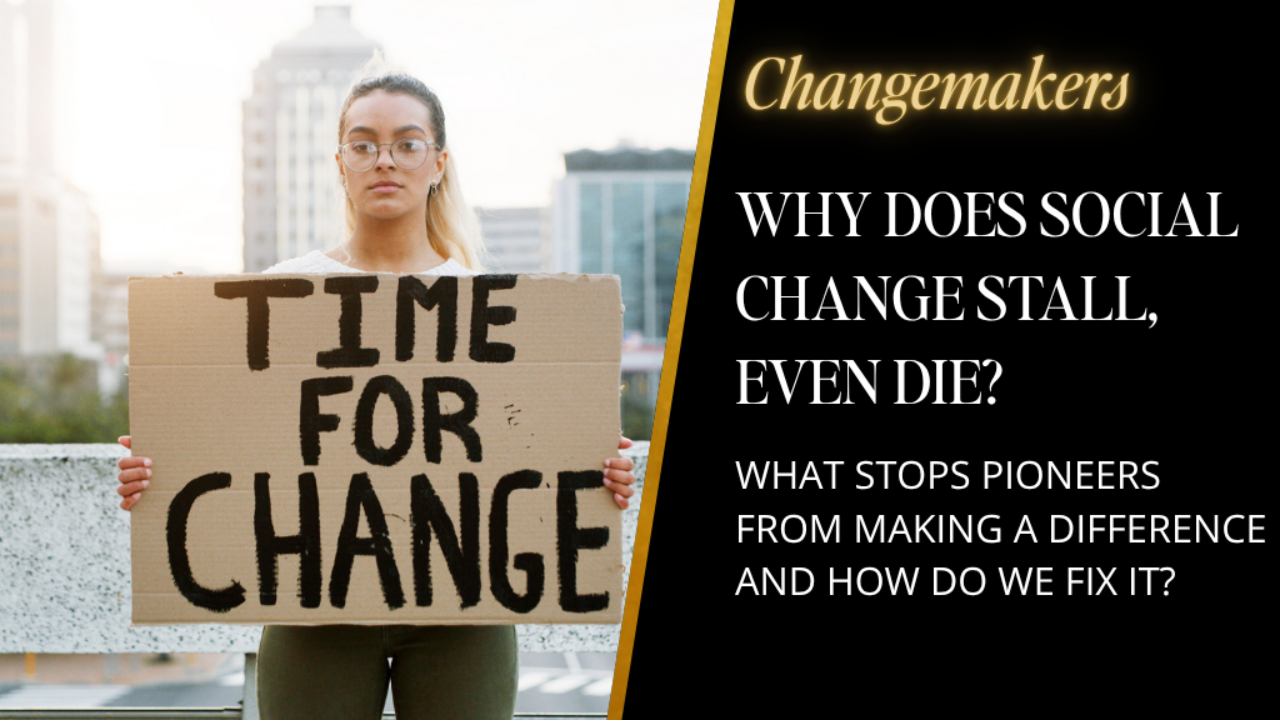
I recently had an extended conversation with facilitator and consultant Mona Ebdrup about exactly this question. The conversation has been published as a podcast, and you can listen to it here:
In the conversation we dig into a paradox:
There's no shortage of ideas, energy, or will in innovation environments, and yet we see, again and again, that promising initiatives lose momentum before they truly take root.
This article is a reflection on some of the challenges that struck me most, and on the dimension that is often the most invisible, but perhaps the most decisive.
Ideas aren't what's missing
Across the World, and not least in Denmark from where I am writing, new communities, regenerative businesses, alternative learning spaces, and system-changing initiatives are springing up. The innovation environments are alive. The visions are strong. The ambitions are high.
And yet we see it again and again:
Good initiatives lose steam. Collaborations get tangled up. Pioneers run out of breath. And projects that began with fire, clarity, and courage stall before they take root.
Yet it's rarely the ideas that fail.
More often it's something subtler, something that, at its core, is about "the human operating system."
When the inner world becomes the hidden bottleneck
Creating something new in the world requires more than creativity and method. It requires inner capacity.
Because when we try to build new structures, we bring all parts of ourselves along. Our wisdom, yes, but also our old patterns, blind spots, need for control or recognition. Our immature ego structures: greed, pettiness, manipulation, dominance. Our tendency to trip ourselves up, especially when the pressure rises. In short, everything we thought we'd already worked through…
I've been part of pioneer settings myself where the dynamics suddenly shift and grown adults start behaving like five-year-olds. This happens, and paradoxically, sometimes especially in environments that call themselves conscious.
We can have worked with personal development for years and still discover that the small, fearful self takes over when something is truly at stake. That old reactions resurface when finances are uncertain. That conflicts become personal, even when the values are shared.
This isn't a sign of failure. It's a sign that we're not just visionary innovators, we're also human.
But if we don't work consciously and deliberately with these unconscious barriers to innovation, they become the invisible factor limiting the impact of our ideas.
It's hard to walk new paths
Something else that became clear in the conversation with Mona is just how demanding it actually is to be a pioneer.
It takes courage to challenge established systems. It takes endurance to hold onto a vision that doesn't yet have broad support. It takes resilience to stand in doubt, slow progress, and financial uncertainty. It takes heroism to keep going, come rain, come shine.
Many innovators aren't just carrying their own dreams. They're carrying the hope that something else is possible for all of us.
That's why it matters that both the innovators themselves and the funds financing new societal experiments take responsibility for pioneers' wellbeing. Having a space where frontrunners can be supported, mirrored, and strengthened isn't a luxury. It's a prerequisite for sustainable innovation.
If the pioneers burn out, the constructive ideas and new initiatives burn out with them.
Being able to live off what you create
There's also a more concrete reality:
If new ideas don't become sustainable businesses for the people who create them, they rarely survive.
Far too many skilled innovators struggle to make the economics work. Not because their ideas lack value, but because inner barriers, collaboration dynamics, or unresolved leadership stand in the way of scaling and stability.
Personal leadership, then, isn't only about self-insight. It's about the ability to make clear decisions. To set healthy boundaries. To enter into mature collaborations. To stand in visibility. To develop persistence - even when the new thing is no longer new and exciting, but consists of long, tough stretches of day-to-day operations. And to create structures that make it possible to live well off what one contributes without compromising one's values.
Consciousness work never stops
Many people in innovation environments are already among the most reflective and engaged people in our society.
But consciousness isn't a level you reach. It's a practice you continue.
If we want to create new systems, we must also be willing to continuously dismantle and develop ourselves. To discover new blind spots, depths, and heights. To let ourselves be challenged. To expand our capacity.
None of us gets off the hook. Because we're all in the same boat. Everyone has an ego. Everyone can be taken over by it. The difference doesn't lie in whether it happens but in whether we have the courage and the community to admit it, and to work with it consistently.
If innovation environments are to be role models for a new kind of leadership, we must also show that development never stops. That complacency isn't an option. That one can be visionary and humble enough at the same time to keep doing the inner work. And that authentic communities where we face both the light and the darkness together are catalysts for the regenerative movement we want to nurture and help flourish.
A larger societal concern
When good initiatives fail to take root, it's not just a personal loss. It's a societal loss.
We live in a time when renewal is more necessary than ever. We need regenerative businesses, new forms of collaboration, and more conscious organizations.
If the people creating these alternatives don't thrive, we lose the chance for the transformation they represent.
That's why work on pioneers' personal leadership isn't just about the individual. It's about protecting and developing the environments where the solutions of the future emerge.
If not us, then who?
When we choose to carry new ideas into the world, we also choose a responsibility.
Not a responsibility to be perfect. But a responsibility to ensure that our inner maturity can match our outer visions.
Because if we, who are already working for change don't prioritize this dimension of leadership, who will?
And if the innovation environments don't flourish, who will show the way toward a more sustainable and life-affirming society that works well for everyone including the pioneers themselves?
Maybe the answer starts there. Not in more ideas but in the way we carry them.
Your Next Step
At Illumina Future Leadership Academy, we help leaders, entrepreneurs, changemakers and their teams thrive today and shape a brighter tomorrow via regenerative resilience, turning crisis into opportunity, and developing AI-complementary human capabilities.
Our next cohorts are forming now.
Start immediately with brain
training that builds up to 25% more focus,
memory, and decision-making skills, plus the neuroplasticity that
maximizes your benefits and transformation when the group
trainings begin.
Continue with trigger-freeing technology to stop allowing the past to interfere with your present and future. Add individual expert sessions to replace career with Calling and learn the 7 Facets of Future-Intelligent leadership.
Schedule a call to explore your options if you feel drawn to this leadership OS upgrade.
Stay connected with updates & news
Join our mailing list to stay in the loop
You can unsubscribe any time with one click
No spam. No sharing with third parties. Only bright ideas & insights. ILLUMINA is latin and means "Please Enlighten Me"