Our leaders toast the Titanic
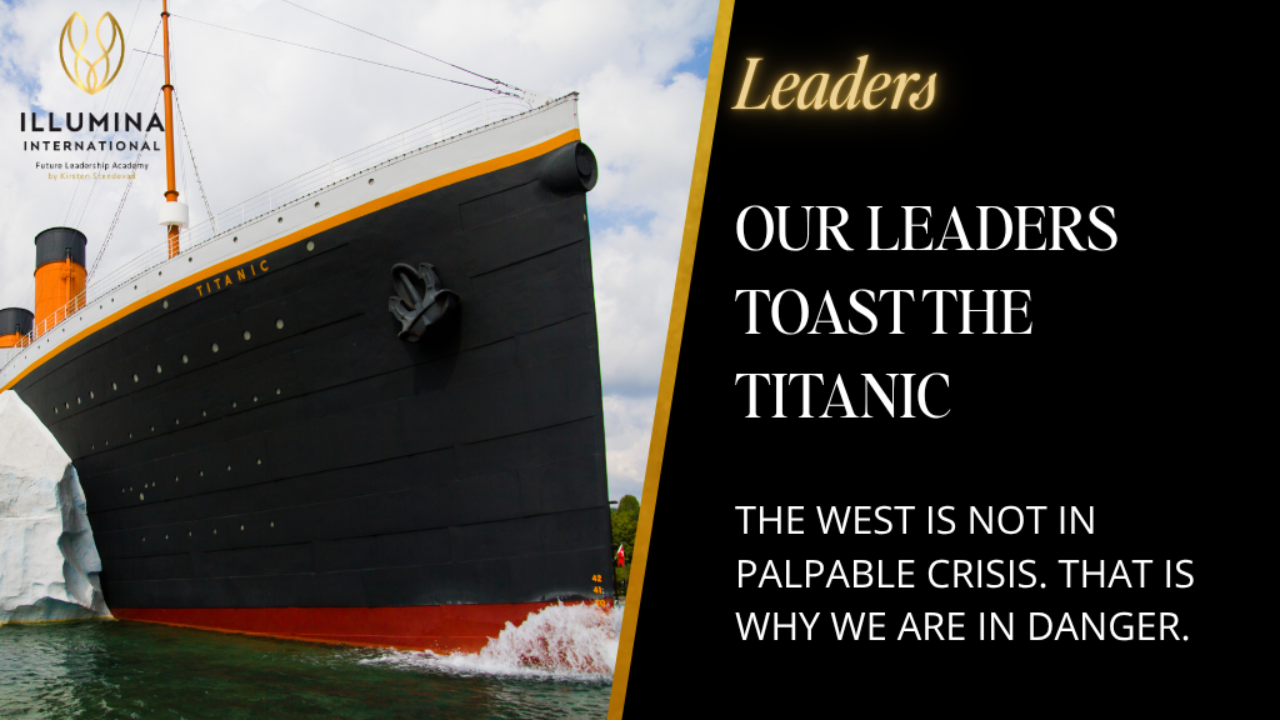
Denmark is not in crisis. That is precisely why we are in danger. We are at the stage where the course can still be changed, and the window is closing.
By Kirsten Stendevad, author, speaker, and founder of the Future Leader Academy
On April 14, 1912, the *Titanic* received at least six ice warnings throughout the day. The ship steamed ahead at near-full speed while dinner was being served.
We tell the story as if the iceberg were the problem. It wasn’t. The decisive factors had been determined long before: that there would be lifeboats for only about half of those on board, and that speed would not be reduced as the warnings came in. None of those decisions were made in a panic. They were made in comfort, by capable and responsible people with sound arguments, while everything still looked fine.
That is what Danish boardrooms, executive suites, and government ministries look like right now. Not incompetent. Confident. And in the process of making decisions that, in five or ten years, will be deemed incomprehensible.
The reason lies in the human operating system most of us function on: the ego. Not vanity, but the fundamental way of perceiving oneself as separate from the whole—and thus, quite logically, optimizing for one’s own position. A separate self has only itself to protect. It is not malice. It is fear making short-term calculations.
A VP at a global corporation recently told me that as earnings no longer come easily, her fellow executives are spending a striking amount of time securing their own careers rather than the company’s future. It is a symptom, and it has been quantified: in 2005, Graham, Harvey, and Rajgopal surveyed more than 400 CFOs, and 78 percent admitted they would sacrifice long-term value to deliver a smooth earnings curve.
It doesn’t even work. In 2017, the McKinsey Global Institute and FCLT Global found that companies truly managed with a long-term perspective saw their revenue grow 47% more than comparable competitors. Ego is not merely unethical; it makes for a poor businessperson.
We see this in politics, where principles are cast aside for the sake of a ministerial post. But let us all take a good, hard look at ourselves before casting stones: none of us—myself included—can claim never to have made decisions where we protected our own interests while calling it "strategy." That is precisely why it is a systemic issue rather than a character flaw.
Danish leaders have received plenty of wake-up calls. For instance, the Danish Defence Intelligence Service has assessed that Russia could pose a credible military threat to NATO countries in the Baltic region within roughly two years, and be ready for large-scale war in Europe without US involvement within five years. The Danish Emergency Management Agency is asking households to be prepared to fend for themselves for three days. And Denmark’s largest company has lost thousands of billions in market value since 2024—a reminder of how quickly earnings we took for granted can vanish.
None of this is a secret. Yet, almost nothing has changed in how we prioritize our time and talent. We have the information, but no change in behavior. This is the defining state of the pre-crisis phase—the only stage where choices come cheap. Once disaster strikes, you no longer make decisions; you simply reap the consequences of the ones you have already made.
I do not understand why Danish leaders aren’t lining up to learn the skills that matter most when the heat is on: maintaining composure while others panic; sensing the right direction before the facts confirm it; standing firm enough within oneself to avoid manipulation; and acting for the greater good—even when it takes heroism to forge new paths before they become mainstream.
Perhaps these leaders imagine it isn’t important? That it isn’t urgent? That it is too "soft" to upgrade one’s internal operating system from an immature ego to a mature—that is, conscious—ego serving one’s essence: that part of us capable of thinking deeply, expansively, and with long-term vision? The benefits of prioritizing one’s inner development during times of stability are well-documented. Through decades of field research, Gary Klein has shown that experienced decision-makers under time pressure do not compare options; instead, they recognize patterns and act on a gut feeling born of condensed experience. In 2009, Daniel Kahneman—intuition’s fiercest critic—concluded alongside Klein that intuition is reliable, provided one has trained for it. In a crisis, data is, by definition, delayed. Anyone waiting for complete documentation decides too late.
The captain of the Titanic did not lack information; he had six telegrams. What he lacked was the capacity to let that information alter his course while the cost was merely his pride.
Three things you, as a leader, should do before the New Year:
Ask this question aloud regarding every major decision: how much is about protecting a position, and how much is about the long-term interests of the whole?
- Conduct a pre-mortem. Imagine it is 2031 and things went wrong. Write down what happened in the past tense. In this exercise, people say things they would never say in a risk analysis.
- Train the capacity, not just the strategy. You do not learn to remain calm in the midst of a crisis. Regulation under pressure is a trainable skill, but it must be practiced in peacetime.
As long as we are driven by ego rather than essence, our shared aircraft will not take off toward the heights that are actually within reach. We squander the energy of an extraordinarily well-functioning society defending the status quo and fighting over seats in the cabin.
The deck is still dry, and the music is playing. This is not a sign that we are safe; it is a sign that we still have a choice.
Your Next Step
At Illumina Future Leadership Academy, we help leaders, entrepreneurs, changemakers and their teams thrive today and shape a brighter tomorrow via regenerative resilience, turning crisis into opportunity, and developing AI-complementary human capabilities.
Our next cohorts are forming now.
Start immediately with brain
training that builds up to 25% more focus,
memory, and decision-making skills, plus the neuroplasticity that
maximizes your benefits and transformation when the group
trainings begin.
Schedule a call to explore if this upgrade answers your calling.
Stay connected with updates & news
Join our mailing list to stay in the loop
You can unsubscribe any time with one click
No spam. No sharing with third parties. Only bright ideas & insights. ILLUMINA is latin and means "Please Enlighten Me"